
Dhakai Jamdani Saree: Price, How to Spot a Real One, and How to Buy from Bangladesh
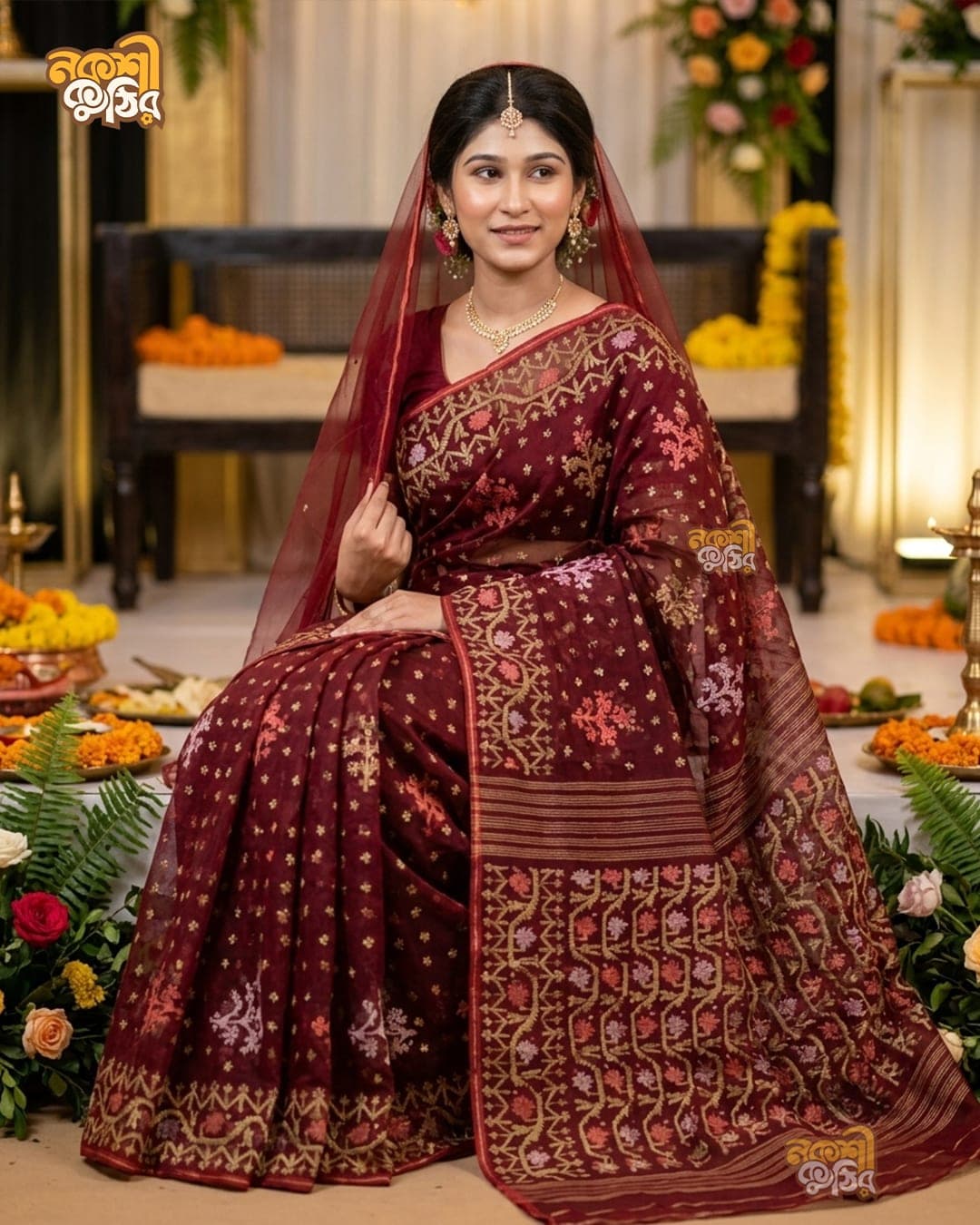
If you have typed "Dhakai Jamdani saree" into Google from Kolkata, London, Toronto or Dubai, you have probably met three problems at once: prices that jump from a few thousand taka to the cost of a flight, pictures that all look alike, and no clear way to tell whether a saree is handwoven in Bangladesh or printed to look that way. This guide answers those three questions in plain English, from a shop that sells Jamdani from Dhaka.
What a Dhakai Jamdani actually is
Jamdani is a fine cotton (sometimes half-silk) saree woven on a handloom around Dhaka, mostly in Rupganj and Sonargaon by the Shitalakshya river. The pattern is not printed or embroidered afterwards: the weaver adds each motif with a separate supplementary thread while the cloth is still on the loom, by hand, motif by motif. That is why a Jamdani can take weeks to finish, and why the design shows on both sides of the cloth.
The craft is about five centuries old in its present form and grew out of the older muslin weaving of Bengal. UNESCO listed the traditional art of Jamdani weaving as Intangible Cultural Heritage in 2013, and Bangladesh registered "Jamdani" as its first Geographical Indication in 2016. The long version, with sources, is in our Bangla history post: জামদানির ইতিহাস.
How to tell a real one from a printed or machine copy
Four checks you can do with the saree in your hands, or on a video call with the seller:
- Turn it over. On a handwoven Jamdani the motif is visible on the reverse too, with the short cut ends of the extra thread. A printed "Jamdani" has a plain or faded back.
- Look at the motif edges. Handwoven motifs are built from tiny steps, so curves look slightly geometric. Perfectly smooth curves usually mean print or machine embroidery.
- Compare two motifs. No two are identical on a handloom; on a power-loom copy they repeat exactly.
- Feel the weight. A 84-count cotton Jamdani is light and slightly crisp; the cheap copies are either stiff and papery (print) or heavy and glossy (polyester).
The common copies on the market are Indian "Jamdani-style" sarees from Uppada and Phulia, power-loom cloth from both countries, and printed cotton. They are not necessarily bad sarees, but they are not Dhakai Jamdani and should not carry its price. More on the differences here: ঢাকাই বনাম ইন্ডিয়ান ও মেশিন জামদানি.
What a Dhakai Jamdani costs in 2026
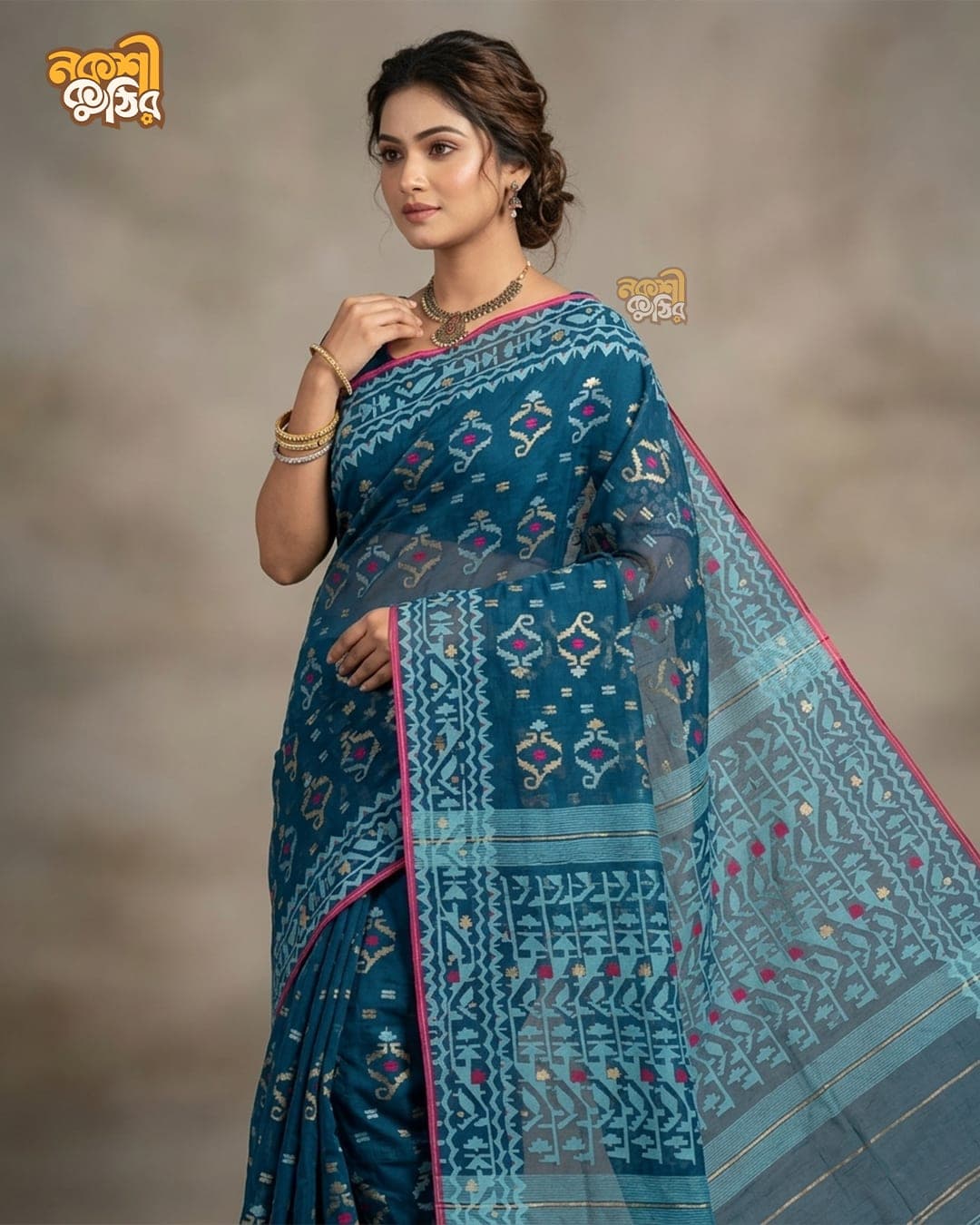
Prices at our shop run from about BDT 2,600 for a simple cotton saree to BDT 75,000 for a densely worked wedding piece; most sarees people buy sit between BDT 8,500 and BDT 28,000. Four things set the price:
- Thread count. 60/80 count is the everyday grade: a little heavier, good for office and family occasions, the most affordable. 84 count is finer and lighter, the usual choice for weddings and gifts. 100 count is rare, very fine and priced per saree.
- Thread type. Cotton, half-silk (silk weft on a cotton warp) and resham. A finely worked cotton can cost more than a plain half-silk.
- How much of the body is covered. A saree with motifs only on the border and pallu costs less than one with all-over work.
- Weaving time. Dense all-over work on fine thread can keep a weaver busy for a month or more; that time is most of what you pay for.
For a rough conversion at the time of writing, BDT 10,000 is roughly USD 80 to 85, GBP 65, or INR 7,000; check the day's rate before you order. The detailed price guide, in Bangla, is here: জামদানি শাড়ির দাম.
Colours and motifs worth knowing by name
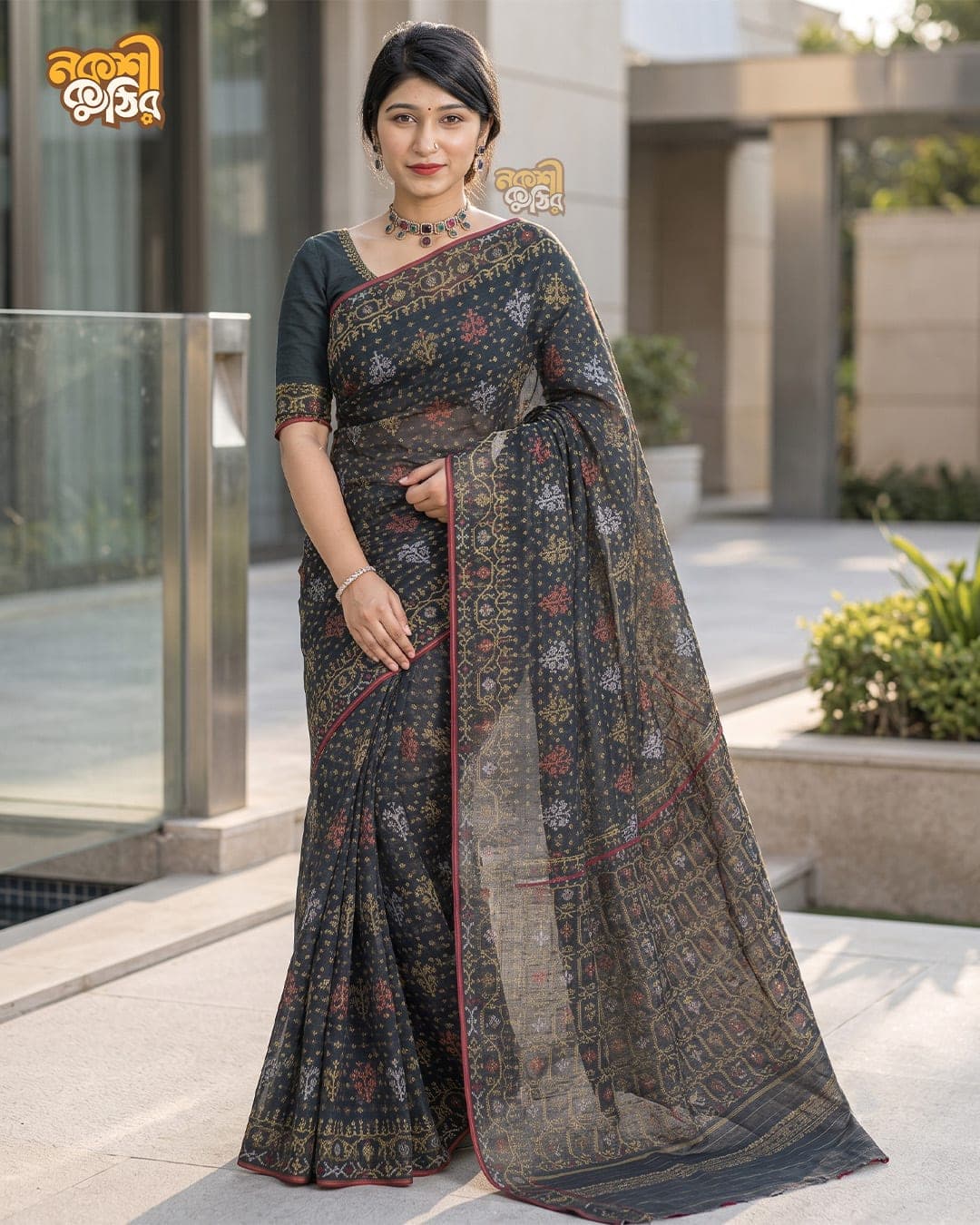
Sellers and weavers use motif names rather than style numbers. A few you will hear: panna hajar (a thousand emeralds, a dense small-flower field), tersa (diagonal stripes of motifs), jaal (a net of motifs over the whole body), kolka (the paisley border), and moyurpyanch (peacock). Red and maroon are the wedding colours; white or off-white with a red border is the Puja saree; black with red, teal, purple and mint are popular for parties and office wear. Our motif glossary with pictures: জামদানির নকশার নাম.
Buying from Bangladesh: how it works at Nokshi Kuthir
- Every saree on our Jamdani saree page has its own photographs, its own thread count and its own price, so you can compare pieces instead of guessing from a catalogue picture.
- Inside Bangladesh: order on the website, pay a 30 percent advance by bKash, and pay the rest in cash on delivery. Delivery takes up to 5 working days in Dhaka and up to 10 working days elsewhere.
- Outside Bangladesh: we ship abroad through international courier. Message us on [WhatsApp](https://wa.me/8801919778974) with the saree link and your country, and we will quote the shipping cost and delivery time before you pay anything.
- Blouse piece: some sarees come with a matching blouse piece woven into the length. The product page says so when it does; if it is not mentioned, ask us before ordering.
- Care: dry clean only (in Bangladesh we call it kata wash). Do not machine wash, do not wring, store folded in cotton and refold every few months so the creases do not set. Full care notes: care guide.
Three questions we get from abroad
- Is it the same quality as the Jamdani sold in Kolkata or Delhi boutiques? Often it is the same saree: a lot of Dhakai Jamdani is bought in Dhaka and resold across the border at a higher price. Buying from Bangladesh cuts out that step.
- Can you weave a specific colour or design? Sometimes, with time and an advance; it depends on the work and on the weaver's queue. Message us with a reference picture and we will tell you honestly whether it can be done and when.
- Do you sell Jamdani for men? Yes: Jamdani panjabi and Jamdani koti (a sleeveless waistcoat worn over the panjabi) are woven from the same cloth, and couples often order a matching saree and panjabi for weddings.
[Ask about international shipping on WhatsApp](https://wa.me/8801919778974)
হাতে বোনা Original Jamdani design, সারা বাংলাদেশে ডেলিভারি।
কালেকশন দেখুন